
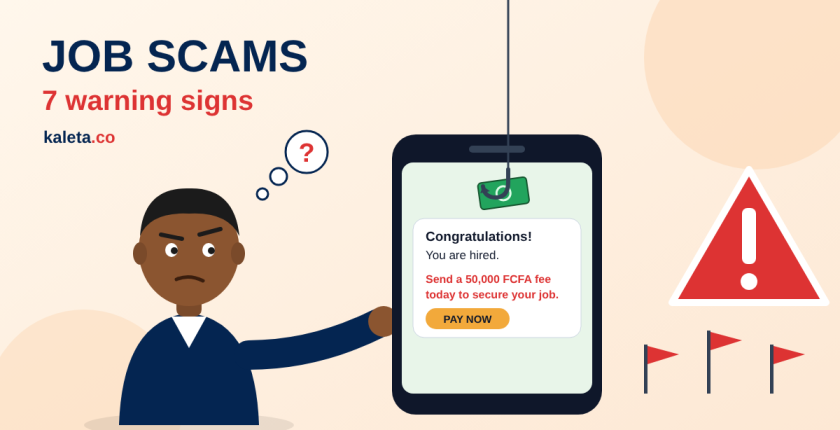
Job scams: 7 warning signs to protect your job search
A genuine employer never asks you to pay to get hired. That is the most important rule to remember. Job scams target people who are actively looking for work, often when they feel the most pressure. Here are seven warning signs that should make you stop and check, and what to do when an offer looks suspicious.
1. You are asked to pay to get the job
Application fees, mandatory training fees, visa fees, medical check fees or a fee to “reserve the position”: any request for money before you are hired is a scam signal. Serious organisations, whether NGOs, UN agencies or companies, cover the cost of their own recruitment. If you are asked to pay by mobile money or money transfer, stop there.
2. The offer is too good to be true
A salary far above the market for a role that requires no experience, an immediate start, a “guaranteed” contract abroad: these promises are designed to make you act fast without thinking. Compare the salary with similar jobs in your country.
3. You are hired without a real interview
A legitimate recruitment process has steps: a CV review, an interview, sometimes a test. A job offer received after a quick exchange of messages, with no questions about your skills, should raise a red flag.
4. The recruiter uses a personal email address
A large organisation writes from its own domain, such as @undp.org or @companyname.com. Be careful with recruiters who write from a free address (Gmail, Yahoo, Outlook) on behalf of a well-known organisation, or from a domain that imitates the real one with a single letter changed.
5. Everything happens only on WhatsApp or Telegram
Messaging apps are useful, but a recruiter who refuses any video call, meeting or official email, and pushes you to answer within the hour, is trying to avoid being checked. Also be wary of groups that promise jobs in exchange for a “subscription”.
6. You are asked for sensitive information too early
A copy of your passport, your bank account number, mobile money codes or passwords: these are only requested after a written, verifiable job offer, and your secret codes are never requested at all. Do not send them to someone you have not verified.
7. The organisation cannot be found, or the job is not on its website
Before replying, look the organisation up: official website, careers page, address, registration number. A real vacancy at a large organisation is usually listed on its own website. If you cannot find it anywhere, or the organisation has no verifiable existence, walk away.
What to do if a job offer looks suspicious
- Do not pay anything, and do not send any personal documents.
- Check the offer with the organisation, using the contact details on its official website, not those given by the recruiter.
- Keep evidence: screenshots of messages, phone numbers, email addresses.
- Report the offer: on Kaleta, email us at [email protected] with the link to the job. You can also alert the police or the consumer protection authority in your country.
- Warn the people around you, especially in groups where the offer was shared.
How Kaleta protects you
Kaleta will never ask you to pay to be hired by an employer. Our paid plans are optional: they give access to platform services, are offered only on kaleta.co, and have nothing to do with any hiring decision. If someone claims to be Kaleta and asks you for money in exchange for a job, it is a scam: please report it to us.
Our team reviews reported jobs and removes those that break our rules.
Search with peace of mind: create your free profile on Kaleta, turn on job alerts and apply to jobs from employers listed in our directory of more than 7,000 organisations.
Turn Insights into Action: Explore Verified Grants, Institutions & Careers
Access 689+ accredited funding windows, 2,500+ verified organizations (UN agencies, DFIs, NGOs, corporates), and high-impact career opportunities across Africa.