
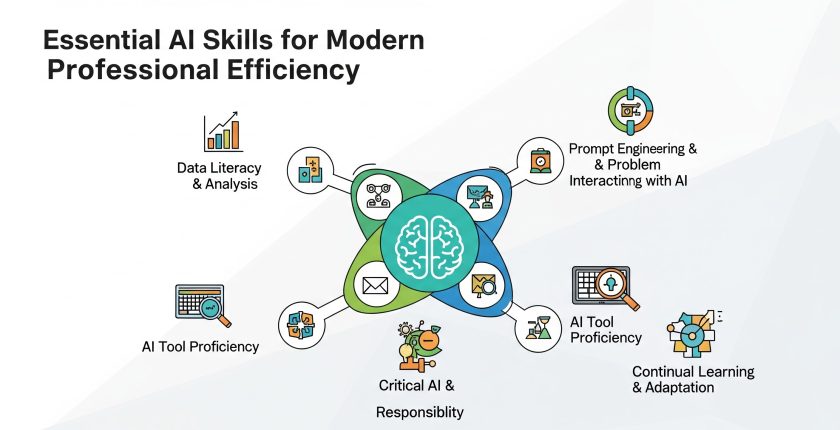
Essential AI Skills for Modern Professional Efficiency
Artificial intelligence (AI) has progressed from a distant vision to a cornerstone of modern workplace productivity. To maintain an edge in this fast-paced environment, professionals must cultivate advanced AI skills that go beyond simple familiarity, enabling them to fully harness the technology’s power for organizational success.
1. AI-Driven Workflow Development and Automation
One of the most immediate ways to boost efficiency is through the automation of routine, repetitive tasks. Professionals should develop the skill to identify manual processes—such as patient scheduling in healthcare, waste monitoring in sanitation, or frequently asked questions in education—and implement AI solutions to streamline them. This mastery of AI workflow development allows individuals to dedicate more effort to strategic and creative endeavors.
2. Proficiency with Large Language Models and Prompt Engineering
Effective communication with AI is a critical skill. Advanced prompt engineering—the ability to craft precise instructions for models like ChatGPT or Gemini—is essential for generating high-quality outputs, from drafting reports to complex problem-solving. Furthermore, understanding how to integrate these models via APIs or frameworks like LangChain can significantly enhance a professional’s technical implementation capabilities.
3. AI-Enhanced Project Management and Decision Making
AI tools are revolutionizing how projects are planned and executed. Modern professionals need to understand how to leverage AI for advanced resource allocation, timeline scheduling, and risk management. By utilizing predictive analytics, professionals can identify potential issues before they arise and use data-driven insights to make more informed decisions regarding policy design and resource distribution.
4. AI Governance, Ethics, and Bias Mitigation
As AI becomes more integrated into professional life, understanding AI governance is paramount. This includes a deep commitment to ethical considerations, such as ensuring fairness, transparency, and accountability in AI deployment. Professionals must be skilled in identifying and mitigating algorithmic bias to ensure that AI-powered tools do not reinforce social inequities or gender disparities.
5. Continuous Learning and Technical Literacy
Finally, the most vital skill is the ability to maintain continuous professional development through AI-powered platforms. Developing a foundational understanding of technical tools like Python for data science and machine learning (ML) enables professionals to better collaborate with technical teams and adapt to emerging trends. This ongoing upskilling ensures that the workforce remains responsive to the challenges of a digitalized future.